
According to recent research, more people are turning to AI tools for search instead of Google. Why? Because AI gives you a direct answer to your question. You don’t need to wade through ads or scan keyword-stuffed content to get to the point. With AI, it’s faster, easier, and, in many cases, more efficient.
Aware of this trend, companies want their brands and content to appear in answers generated by AI assistants like ChatGPT and other AI search platforms. But can they actually influence their visibility? And if so, to what extent?
In this article, we’ll discuss what it takes to become visible in AI search.
AI crawlers don’t all see the same page
Have you ever thought about how an AI bot sees a webpage and judges its value?
Unlike humans, bots don’t appreciate beautiful layouts or design elements. What matters at the crawling stage is whether the page content is accessible and how efficiently it can be extracted. In other words, how much computing power it takes to access and process that content.
JavaScript-heavy pages are computationally expensive to render. If important information is loaded only after scripts execute, a crawler may need to download additional resources, run the code, and wait for the content to appear. Some crawlers can perform these steps; others may not execute JavaScript at all, potentially missing important information. In the worst case, they may receive an almost empty HTML document.
Googlebot and AI-related crawlers don’t all behave the same way. Their rendering capabilities depend on their purpose and underlying technology. Let’s compare them.
| Crawler | Purpose | Documented JavaScript Reneding Capabilities |
|---|---|---|
| Googlebot | Discover and index pages for Google Search. | Supports JavaScript rendering using an evergreen Chromium-based engine. Rendering occurs as a separate processing stage. |
| Bingbot | Discover and index pages for Bing Search. | Supports JavaScript execution and page rendering using Microsoft Edge’s Chromium-based engine, with regular engine updates. |
| OAI-SearchBot | Discover content for ChatGPT Search. | JavaScript rendering support is not publicly documented. |
| GPTBot | Crawl content potentially used for AI model training. | JavaScript rendering support is not publicly documented. |
| ChatGPT-User | Fetch pages during certain user-initiated ChatGPT actions. | JavaScript rendering support is not publicly documented. |
| ClaudeBot | Crawl content potentially used for training Anthropic’s models. | JavaScript rendering support is not publicly documented. |
| PerplexityBot | Discover and index content for Perplexity search. | JavaScript rendering support is not publicly documented. |
It also helps to remember that “crawling” covers more than one behavior. Bots like GPTBot, ClaudeBot, and PerplexityBot discover and fetch pages on their own schedule, much like Googlebot. Agents like ChatGPT-User only fetch a specific page when a user’s question triggers it. And several AI search products rely heavily on an existing search index, such as Bing’s or Google’s, rather than crawling the entire web themselves. For many sites, being well indexed by traditional search engines is still the first gate to AI visibility.
Does this mean bots simply skip difficult content? Not necessarily. But rendering and processing a complex page will require additional work.
Venkata Pagadala, Lead Technical Product Manager at AT&T, Researcher and Speaker, explains this using a highway-versus-hills analogy. A car with a limited amount of fuel can travel farther on a straight highway than on a winding mountain road with constant climbs and descents. The same principle applies to web crawlers. They operate with finite computing resources, and the more work a page requires to render and process, the more expensive it becomes to retrieve its content.
The diagram below illustrates a simplified crawling and indexing workflow.
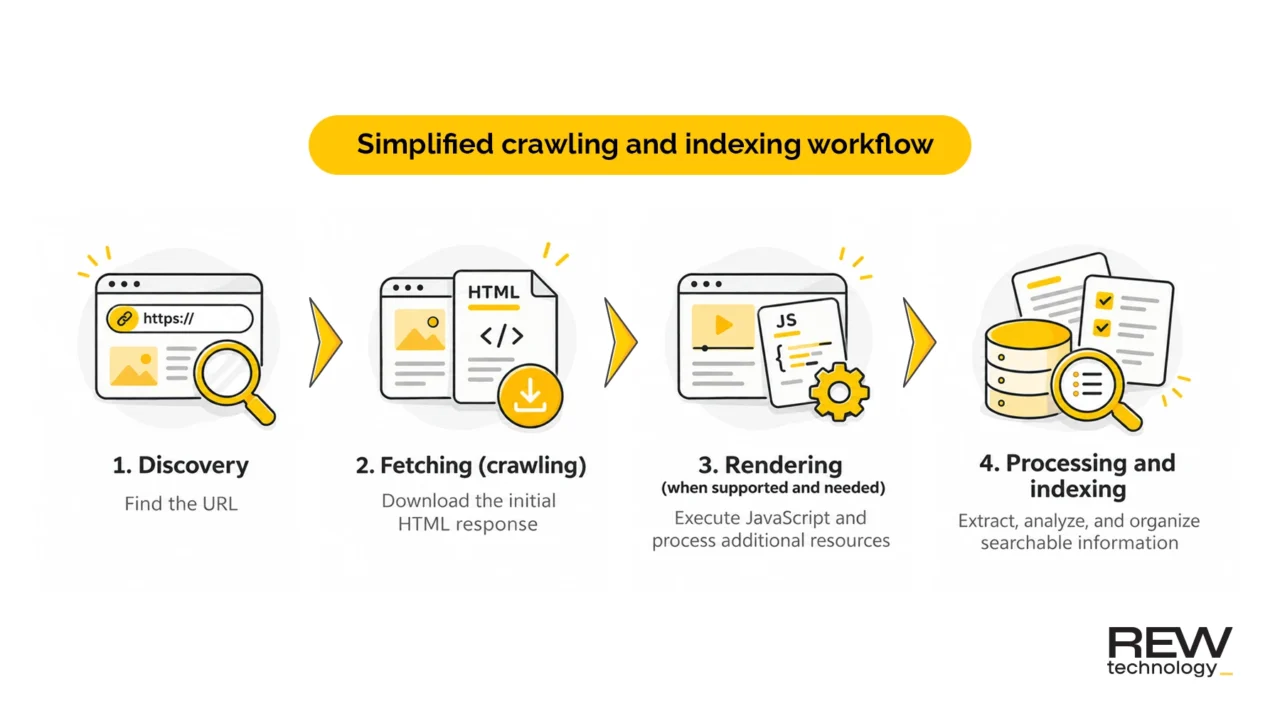
So what can website owners do to make their content more accessible to AI crawlers? The first step is to remove technical barriers through a few practical engineering measures:
- Allow relevant crawlers in robots.txt and ensure CDN or firewall rules don’t block their legitimate requests.
- Use server-side rendering or static HTML generation to make content available without requiring JavaScript execution.
- Make important pages publicly accessible, with meaningful content available in the initial HTML.
- Use descriptive headings, sensible internal links, and a consistent page structure.
- Provide XML sitemaps and ensure important URLs return appropriate HTTP status codes.
- Test what different crawlers can actually retrieve from your pages, rather than assuming that content visible in a browser is equally accessible to bots.
Of course, reducing JavaScript dependencies and providing clear, well-structured content helps remove barriers for crawlers. But the truth is, just because an AI bot can access your content doesn’t mean an AI assistant will ever mention it in an answer.
Being crawled doesn’t mean being cited
This happens because these two events belong to different, though closely connected workflows: crawling, which we described above, and answer-time retrieval.
So, what actually happens between an AI bot finding your content and an AI assistant suggesting it as a source?
The diagram below illustrates a possible workflow for generating an AI search answer.
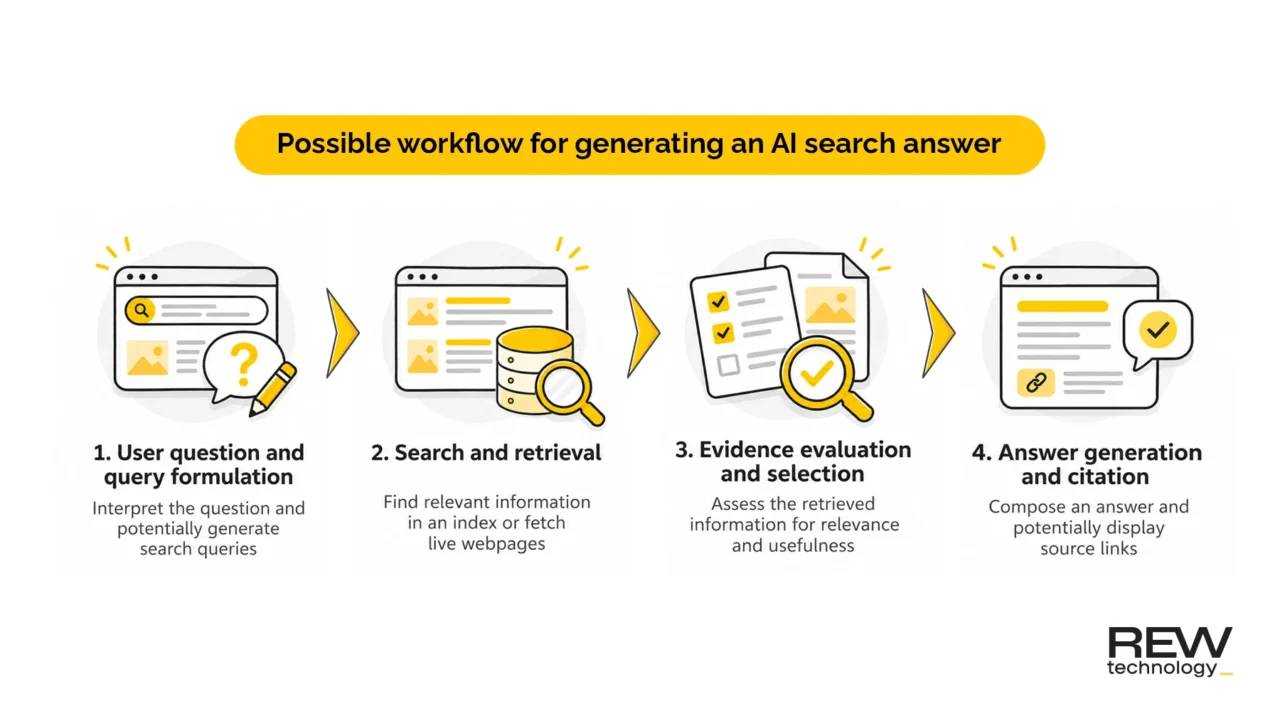
When an AI search system receives a complex query, it may break it down into several targeted searches. This technique is called query fan-out. For example, when processing a question like “Which platforms are best for enterprise data integration?”, the AI system may generate separate queries about platform comparisons, enterprise features, or integration capabilities. This approach broadens the search results, provides better context, and helps improve the relevance and completeness of the answer.
Then comes search and retrieval: the system looks for relevant information in an existing search index or fetches it directly from webpages. Pages ranking higher for these targeted searches may have a better chance of being retrieved, although conventional search rankings don’t necessarily predict which sources an AI system will use.
At the next stage, the system evaluates the retrieved information and selects the most relevant and useful sources. Google, for example, emphasizes helpful, reliable content that provides original information or analysis. Relevance, reliability, freshness, and other signals may influence the selection decision.
Lastly, the system generates an answer and potentially displays source links. But even when content is retrieved and considered, it may not receive an explicit citation.
This is primarily because AI systems generate answers by synthesizing information rather than simply reproducing search results. They may retrieve multiple relevant sources, but only some appear as citations in the final answer. In other words, a citation is not a complete record of everything the model retrieved or considered.
The problem with today’s AI visibility metrics
As we have seen, being crawlable doesn’t necessarily mean being cited. But even when a citation appears, how much does it actually tell us about your brand’s visibility in AI search?
Today, a growing number of Generative Engine Optimization (GEO) tools promise to measure how often brands appear in AI-generated answers. Most use a relatively straightforward approach: they submit predefined prompts to AI assistants, collect the responses, and count brand mentions, citations, or positions relative to competitors.
At first glance, the approach seems logical. But things are not that simple.
Unlike traditional search results, AI-generated answers can vary considerably, even for the same question. Different models may produce different answers even when given similar information. Different search products may use different indexes, retrieval methods, ranking systems, and citation mechanisms.
A recent research survey, Optimizing Visibility in Generative Engines (Martinez, 2026), illustrates just how little overlap there can be between different AI search products. A peer-reviewed audit of Bing Chat and Perplexity (Li and Sinnamon, 2024) identified 355 unique cited domains, of which only 26% were cited by both systems. Another study comparing Google Search, AI Overviews, and Gemini across 11,500 queries (Grossman et al., 2026) found URL-level overlap scores of just 0.11 to 0.18, meaning that only about 11 to 18% of distinct URLs were shared between the compared systems.
In other words, these systems drew on substantially different sets of websites.
And the results aren’t necessarily stable even within the same platform. A study that tracked four AI search engines over 45 days (Schulte et al., 2026) found considerable variation in cited sources, both across different days and between repeated tests within 24 hours.
None of this makes GEO tools useless. They are a reasonable way to get a directional read on where a brand stands. But their measurements reflect visibility on particular platforms, within particular sets of prompts and tests, not necessarily across the questions real customers ask.
For that reason, Venkata recommends treating third-party scores as one input rather than the whole picture, and pairing them with data companies can collect or verify themselves: server logs, search platform data, and actual referral traffic.
We can use a standardized measurement framework across search engines and AI platforms, even though they employ different crawlers. The starting point is log analysis, where we identify and filter crawler activity to understand which bots visit our website and which URLs they request. We then combine this information with first-party data from Google, Bing, and our own website analytics to examine referral traffic and its contribution to business outcomes.
Venkata Pagadala
Your customers don’t all ask the same questions
Venkata sees a bigger gap in the way companies typically monitor how often their brands appear in AI-generated answers. Different users search for the same thing in completely different ways, and most measurement programs don’t account for this.
Let’s take a company selling electric cars as an example.
An AI visibility tool might regularly ask ChatGPT: “What are the best electric cars in 2026?” Then it checks whether Tesla, Hyundai, Volkswagen, or another brand appears. If Tesla is mentioned in 7 out of 10 answers, the platform might report a 70% mention rate for that particular test.
But real customers don’t necessarily ask such generic questions. A parent with three children, a university student, and a retired person might all be looking for an electric car, but their needs and questions could be completely different.
The diagram below illustrates how one product category can span different customer needs.
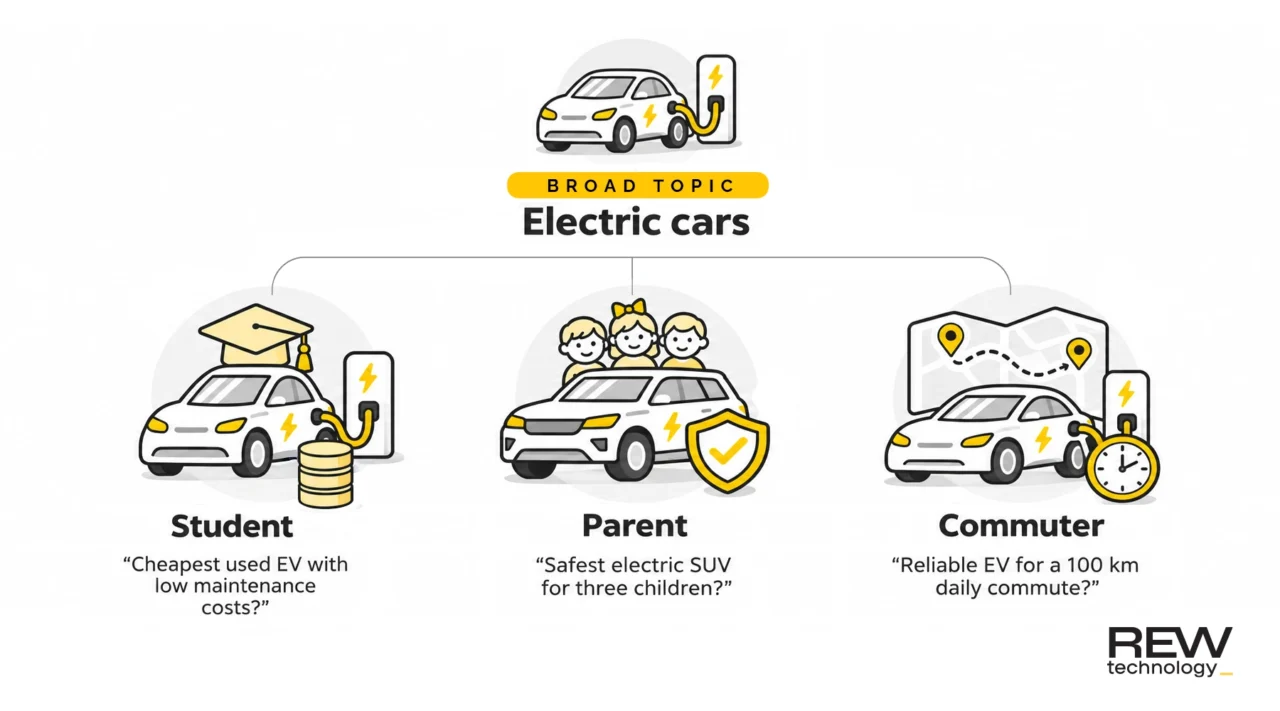
To obtain more representative measurements, companies need to understand who their customers are, why they buy, and how they formulate questions.
This notion is central to a persona-based query fan-out framework that Venkata is building. It involves identifying target audience personas and modeling how each would query AI platforms. He also recommends repeating queries across different AI platforms and tracking results over time, rather than relying on one-off tests.
This approach allows companies to measure their visibility across different customer segments and search intents, something that generic prompts alone might fail to capture.
Testing changes before scaling
When even the same AI product can produce different answers to the same question, it’s difficult to say for sure which optimization techniques actually work. But it’s not all bad. Venkata Pagadala believes the way forward lies in experimentation and continuous optimization.
Suppose you’ve identified several changes that might improve your website’s visibility in AI-generated answers. Should you implement them across hundreds of pages at once?
Venkata advises against it. Before scaling, test the changes on a limited group of pages, using a representative set of queries. Establish a baseline, introduce the changes, and compare the results over repeated tests. Where possible, keep a comparable group of pages unchanged to help distinguish the effect of your intervention from ordinary fluctuations.
If the results are encouraging, expand the experiment gradually.
But always account for the volatile nature of AI: even a successful experiment may not remain successful for long. As AI models evolve, and retrieval and ranking mechanisms change, search products may also change how they discover and present information.
A technique that works today may need to be reconsidered tomorrow. For this reason, GEO is better approached as a continuous cycle of testing, measurement, and adjustment rather than a one-time optimization project.
Conclusion
In the course of this article, we tried to understand what it takes for your content to be cited by AI. And though there’s no universal trick, following certain practices can improve your chances of success.
- Make your pages accessible to crawlers through technical adjustments.
- Create high-quality, informative content relevant to users’ questions.
- Make optimization an ongoing process, with regular testing across different platforms and customer queries.
Now as you understand how AI and search crawlers access your content, make sure they can continue doing it as your website evolves.
REW Technology can help you create automated regression tests to catch crawler-access and content-availability issues before deployment. Supplemented with detailed failure reports, these tests can become part of the software delivery process, ensuring accessibility of your content.